Dog Behaviour / Expert Briefing
Your Dog Isn't Giving You a Hard Time. They're Having One.
The lunging, the barking, the crying behind the door: almost none of it means your dog is "bad". It means they need better tools, and you can start giving them at home.


Your dog loves you. They greet you at the door. They lean into you on the couch.
By every measure that matters, they are yours.
And then the leash clips on, or the door closes behind you, and a completely different animal takes over. The lunging. The barking that wakes the building. The pacing and whining the second you leave.
But here is the part no one talks about. The hardest part was never the behaviour itself. It is what the behaviour slowly does to you.
You start walking at odd hours, when the street is empty. You stop inviting people over. You cross the road before the other dog gets close. You carry a low, constant guilt to work, half-waiting for the neighbour's message. And somewhere along the way you start to wonder, quietly, if you are simply not a good enough owner.
Most owners are told the same thing: be firmer. Be the boss. Show them who is in charge.
Here is what almost no one tells you. The dog doing those things is not being dominant, stubborn, or bad. They are a frightened or over-aroused dog who has tipped over an invisible line, and the popular fixes push them further across it.
Once you can see that line, everything you have been struggling with starts to make sense, and finally starts to change.
If "Being the Boss" Made It Worse, You Weren't Failing
If you have tried the loud "NO", the leash-jerk, the spray, or the collar that corrects, and the problem only got worse,
you were not doing it wrong. You were handed the wrong tool.
Punishment can stop a behaviour in the moment. But it does it by adding fear, and fear is the root cause of most of this in the first place. You suppress the bark, the fear stays. You suppress the lunge, the panic grows. The dog gets quieter, and more anxious underneath.
And every time it fails, it costs you a little more. A little more hope, a little more patience, a little more belief that this can ever get better. It can. You have just been aiming at the symptom instead of the cause.
You cannot punish a dog out of panic. You can only teach a dog out of it.
The Invisible Line Every Calm Dog Stays Behind
Trainers have a name for that line. They call it the threshold.
Below it, your dog is alert but still thinking. Above it, stress hormones flood in and switch the thinking brain off entirely. This is the whole game.
- Below threshold, your dog can learn.
- Above it, they physically cannot, no matter how firm you are.
- Almost every "my dog won't listen" moment is really a dog already over the line.
Keep your dog just below that line. Reward the calm you want to see again. Close the gap by inches. The behaviour changes because the feeling underneath it changed. That single principle has a name, and it is the spine of everything that follows: the Under-Threshold Method.
Once you can see the line, the three things driving you up the wall finally make sense.
 1
1
The Walk That Feels Like a Fight
A lunging dog is rarely an aggressive one. Far more often it is frightened or frustrated, pushed over the line by a trigger that came too close. You brace, you shorten the leash, you scan every corner, and the walk you used to love becomes the part of the day you quietly dread. Work at the distance where your dog can still think, and the leash stops being a tug-of-war.
 2
2
The Guilt Every Time You Leave
The whining and scratching are not your dog being needy. They are genuine panic, the moment your dog tips over the line alone. And you feel it too: the guilt you carry to work, the camera you keep checking. Alone-time tolerance gets rebuilt the way a muscle does, in small planned steps, starting at one second by the door.
 3
3
The 6 A.M. Barking and the Neighbours
Most barking like this is a dog with no outlet and an alarm system stuck on. You lie awake bracing for the next round, half-apologising to the neighbours in your head. You do not quiet it by shouting back. You give the energy a job and teach the off-switch, most of it indoors, in minutes.
You Don't Need a Class. You Need a Plan You Can Run at Home.
Group classes move too fast for a reactive dog. Private trainers add up fast. Ten contradictory videos at midnight leave you more lost, not less. Every option asks for more time, more money, or more nerve, and you are already running low on all three.
What is missing was never effort. It is a clear, gentle, step-by-step plan you can run in the room where the problem actually happens, in short sessions that fit a real life.
Meet The Calm Companion
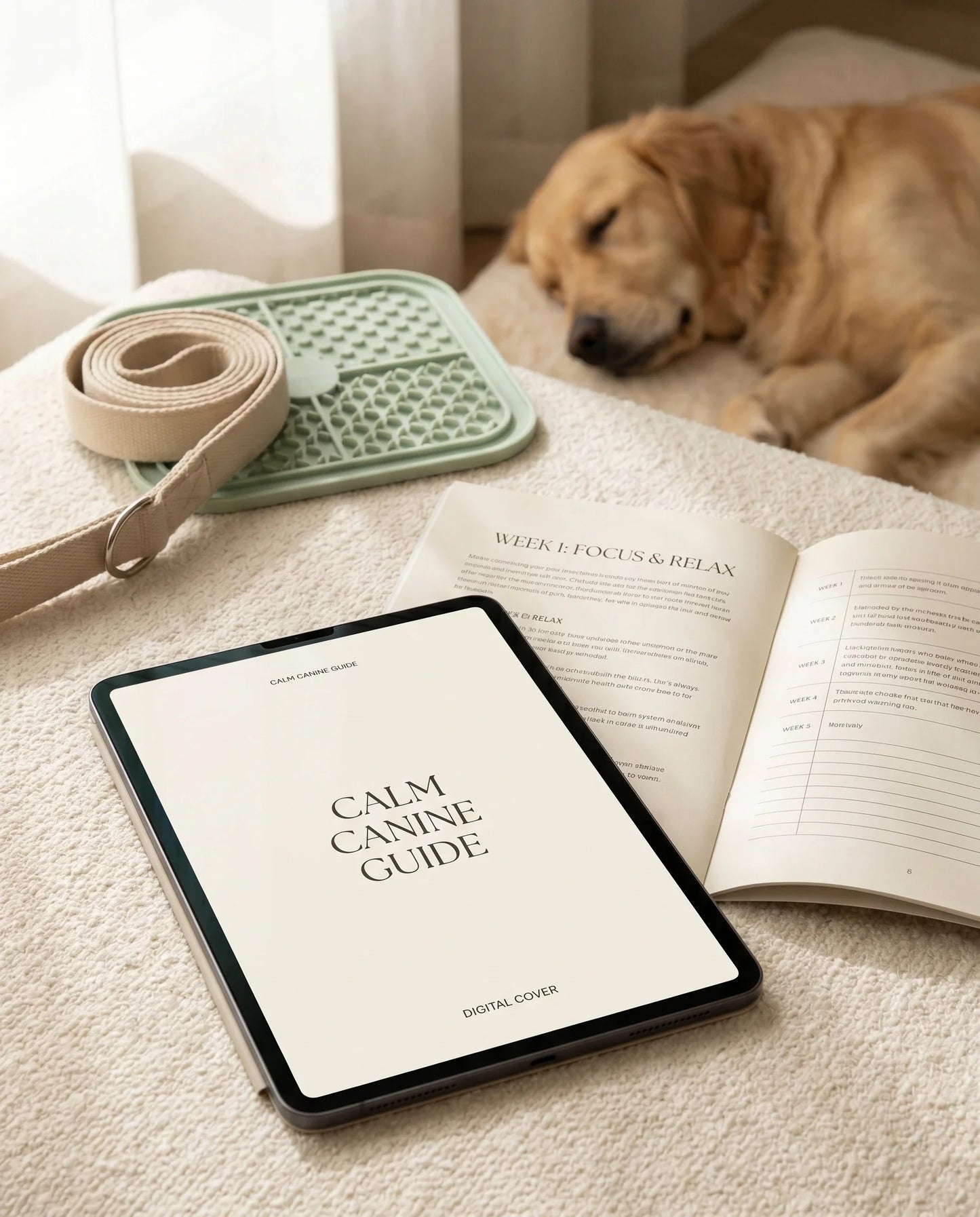
A complete, force-free behaviour program you run from your own living room. No prong collars, no shock, no "dominance". No special equipment. Field-tested by a working trainer and written so an ordinary owner can actually follow it.
It is not just about a calmer dog. It is about the walk you look forward to again, the morning that stays quiet, the goodbye that stops hurting, and the bond you wanted in the first place.

What's inside
- The Under-Threshold Method, the principle behind every protocol
- The absence ladder that rebuilds calm alone-time from one second, upward
- "Look At That", the game that turns a trigger into a cue for calm
- A settle routine, a portable off-switch for barking, guests, and bedtime
- A done-for-you 7-day starter plan plus a progress tracker
Instant access · 30-day money-back guarantee
Our rescue used to lose it at every dog on the street. Two weeks in, he glances at a dog and then looks back at me. I can finally enjoy our walks.
The absence ladder changed our mornings. He no longer panics when I pick up my keys, and the barking my neighbours used to message me about has basically stopped.
I was skeptical of a do-it-yourself program, but the 7-day plan told me exactly what to do each day. First time I have felt like I understand my own dog.
A fair word. Progress here is rarely a straight line, good days and backslides are both normal, and the program shows you how to read them. Severe cases take longer, and the guide is honest about when a situation calls for your vet or a hands-on professional instead. This is not a miracle. It is the same gentle, reward-based approach a good trainer would coach, written so you can run it.